
21 Apr, 2026
Maritime Law and Legal Practice: A Comprehensive Overview for Future Legal Professionals
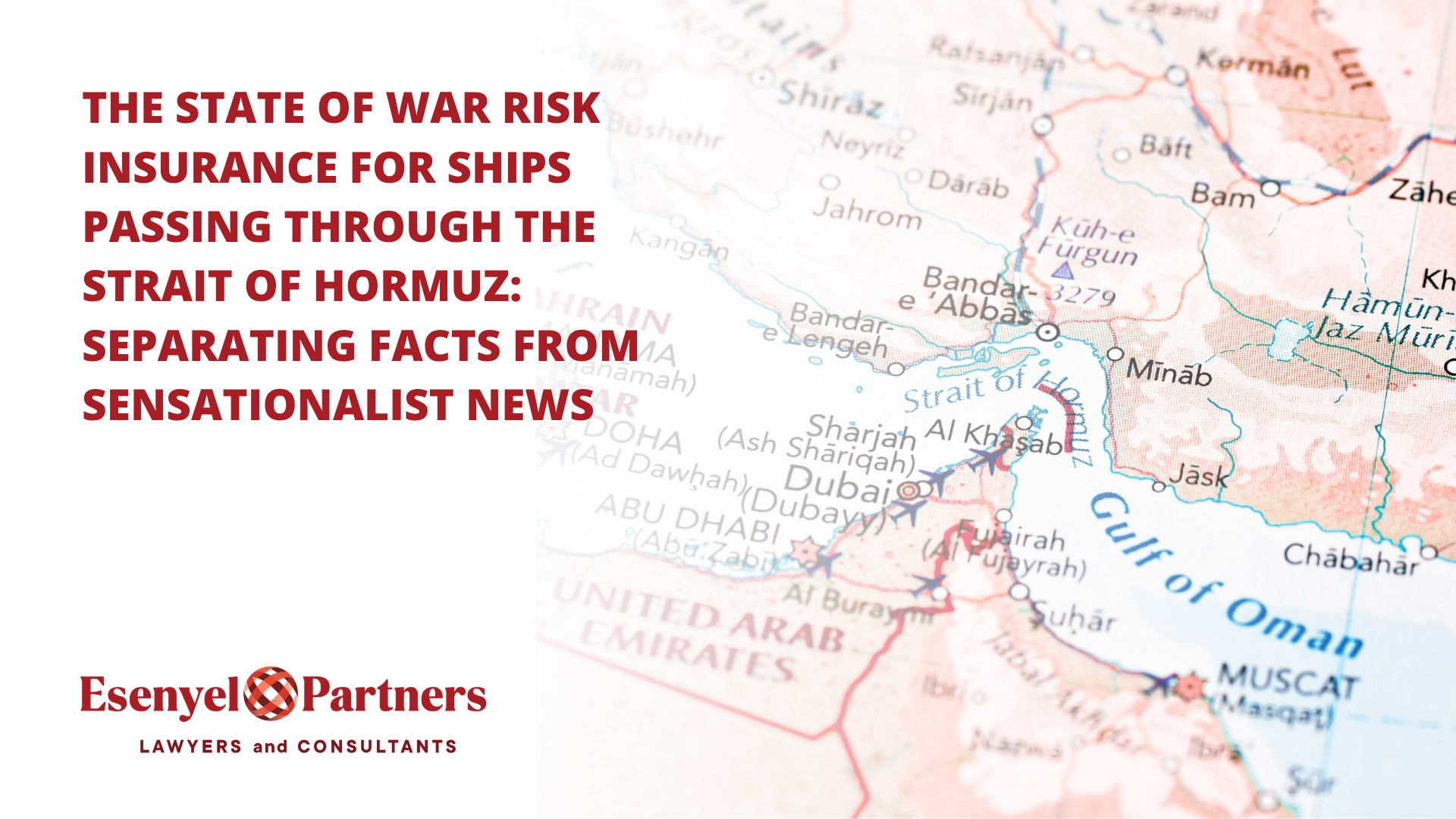
Since the beginning of 2026, escalating geopolitical tensions in the Middle East, specifically within the USA-Israel-Iran axis, have caused profound tremors in the Strait of Hormuz, one of the most critical bottlenecks of global maritime trade. According to U.S. Energy Information Administration (EIA) data, this strategic waterway, through which approximately 20-21% of the world’s seaborne crude oil and condensate passes, has suddenly become the epicenter of hot conflicts and retaliatory attacks. While this situation has caused great concern among shipowners, charterers, and cargo owners, it has also raised serious questions regarding the sustainability of international supply chains.
In this atmosphere of chaos, intense and sensationalist news has begun to appear in the mainstream media and parts of the maritime press, suggesting that war risk insurance for ships has completely disappeared and that the strait has become “uninsurable” for commercial vessels. However, a close examination of maritime law and the dynamics of the insurance market reveals that these claims do not fully reflect the reality.
The perception in the media that “insurers have completely withdrawn from the region” is primarily based on the 72-hour Notices of Cancellation (NoC) issued by P&I Clubs (Protection and Indemnity Clubs) and other marine insurers. This notification mechanism stems from the provisions of Institute War and Strikes Clauses (Hulls–Time) 1/10/83 Cl.3 and Institute War and Strikes Clauses (Cargo) 1/1/2009 Cl.3. Following the intensification of conflicts, many international insurance consortiums issued these notices, which was interpreted by the public as a definitive termination of insurance.
In the context of maritime insurance law, however, these notices do not mean that coverage has ended permanently or entirely. As emphasized by the International Union of Marine Insurance (IUMI), this is a highly standard procedure. Insurers use these notices for “Listed Areas” where risk has suddenly spiked to suspend current policies, reassess the risk, and reinstate the policy with updated terms, warranties, or Additional Premiums (AP). In short, insurance protection has not vanished; rather, pricing and risk conditions have been brought back to the table for renegotiation.
Attributing the serious decline in ship traffic in the Strait of Hormuz solely to a “lack of insurance” is to overlook the root of the problem. The Lloyd’s Market Association (LMA), the heart of the London insurance market, has explicitly denied these sensational reports in its official statements. LMA officials stated that war risk insurance capacity is still available in the London market and globally, and that shipowners who wish to do so can continue to obtain this coverage.
The real reason for the dramatic drop in commercial vessel traffic in the region is not financial or insurance-related, but entirely due to physical security concerns. Ship captains and owners are refraining from entering the region because they find the risks to crew safety and the safety of the vessel to be unacceptably high. In other words, ships are not avoiding the Strait of Hormuz because they cannot find insurance, but because of the massive risks to life and property inherent in navigating through an active war zone.
The fact that war risk insurance is “available” in the market does not mean it is “cheap” or “easily accessible.” War risk premiums, which were approximately 0.25% (2.5 per mille) of a vessel’s Hull & Machinery (H&M) value before the conflicts, have skyrocketed to the 1% to 5% range, and in extreme cases, even to 10%. For massive tankers worth millions of dollars, the insurance cost for a single transit can reach tens of millions of dollars.
Furthermore, due to market uncertainty, the validity period for insurance quotes has dropped from 24 hours to as low as 12 hours, making operational planning extremely difficult. While this is not a de facto military blockade, the astronomically rising costs create a “financial blockade” that is commercially insurmountable. Although international market-stabilizing initiatives, including attempts to increase reinsurance capacity, are on the agenda, the financial pressure on shipowners remains severe.
Another critical dimension of the crisis in the Strait of Hormuz is the right of passage under the United Nations Convention on the Law of the Sea (UNCLOS). The strait holds the status of a critical waterway open to international navigation, and under UNCLOS Articles 37-44, ships have the right of transit passage. UNCLOS Art. 44 imperatively dictates that coastal states cannot suspend transit passage, while Art. 38/1 stipulates that transit passage must be “continuous and expeditious.”
However, the fact that Iran has not signed and ratified the 1982 Convention creates a critical legal uncertainty regarding the transit passage regime. Iran asserts that it holds the position of a “persistent objector” against this regime. According to this doctrine, which finds its roots in the ICJ’s Anglo-Norwegian Fisheries (1951) decision, if a state has consistently and continuously objected to a customary rule during its formation, that custom may not bind said state. While Iran’s argument has a serious legal basis, its international acceptance is highly controversial; Iran’s occasional de facto consent to transit passage (acquiescence) may weaken its status as a persistent objector.
Risks such as interference with navigation, stopping, or detention of ships by coastal states for military security reasons are among the fundamental perils covered by war risk insurance. The ICJ’s Corfu Channel (1949) decision is the landmark precedent confirming that the right of passage through international straits cannot be prohibited by the coastal state, even in peacetime.
Evaluating the legal situation in the Strait of Hormuz solely from the perspective of peacetime law of the sea does not align with current reality. Iran is in a de facto International Armed Conflict (IAC) with the US-Israel coalition. According to the ICRC’s conflict classification framework, an armed conflict between two or more states constitutes an IAC, regardless of whether the parties formally recognize it as such (Common Article 2 of the Geneva Conventions).
As a direct result of this classification, Iran possesses belligerent rights within the framework of jus in bello. These rights include:
It is important to note that the San Remo Manual on International Law Applicable to Armed Conflicts at Sea (1994) is not a binding international treaty but a restatement of customary law. Nonetheless, as an authoritative source widely accepted in international maritime law, it is the primary reference text used to determine the limits of a belligerent’s rights.
The possibility of Iran implementing a selective blockade, particularly against US and Israeli-flagged vessels or those carrying cargo destined for these countries, constitutes one of the most critical risk factors directly affecting the insurance market. In evaluating the scope of war risk insurance policies, ignoring this IAC dimension is a legally unacceptable omission.
In the event of a full or partial closure of the Strait of Hormuz, force majeure clauses in carriage contracts, commodity sale contracts, and charterparties will come into play. Under the ICC Force Majeure Clause 2020, Art. 1(e)-(g), war, hostilities, and blockades are listed as types of force majeure events.
However, it must be emphasized that the ICC 2020 model clauses are not binding legal norms; they apply only if explicitly incorporated into the contract by the parties. Therefore, it is mandatory to examine the force majeure provision of each contract individually. Exemption from liability due to an impediment under CISG Art. 79 and the doctrine of frustration of purpose in English law should be evaluated in parallel.
This extraordinary and volatile situation in the Strait of Hormuz brings with it complex legal disputes in the field of maritime commercial law. How the war risk clauses in charterparties signed between shipowners and charterers will be interpreted in light of current events is of great commercial importance.
The BIMCO CONWARTIME 2013 (time charterparty) and VOYWAR 2013 (voyage charterparty) clauses grant the shipowner the right to refuse to proceed to ports or waters declared as war zones. These clauses are triggered by definitions of “war, warlike operations, hostile acts,” and the current conflict environment in the Strait of Hormuz, especially considering Iran’s status as a party to an IAC and the active hostilities in the region, should be considered within the scope of these definitions.
In this context, the following questions are of critical legal importance:
In this challenging period, it is a vital necessity for maritime companies to conduct a detailed review of the “War Risk” coverage and navigating limits of their existing insurance policies with the assistance of specialized lawyers. When notices of cancellation are received, strategic steps must be taken immediately to negotiate new terms and additional premiums.
Furthermore, how increased delay and freight costs will be reflected in commercial contracts, the timing of force majeure notices, and the adaptation of charterparty clauses to the current risk environment must be carefully planned.
To summarize, widespread and sensational reports suggesting that war risk insurance has completely disappeared in the Strait of Hormuz in recent days do not reflect the truth; coverage is still available in global markets, but costs and legal conditions have become dramatically more onerous. The primary reason for the standstill in ship traffic in the region is not the inability to find insurance in the market, but the actual environment of hot conflict that directly threatens the lives of seafarers and the safety of massive commercial vessels.
The maritime industry has faced crises throughout history and has always known how to overcome these challenges. However, minimizing the cost of such complex crises is only possible through accurate market information, correct analysis of current legal frameworks, especially IAC/jus in bello and force majeure dimensions, and the construction of a solid legal foundation.
For more information and legal support on these matters, you may contact Esenyel & Partners.
Your personal data; protecting the privacy of visitors to the website (www.esenyelpartners.com), operated by Company Name (“COMPANY” or “Esenyel Partners” as it will be referred to), as the data controller, is one of the leading principles of our Institution. This Cookie Usage Policy (“GDPR”) explains to all our website visitors and users under what conditions and which types of cookies are used.
Cookies are small text files stored on your device or network server by the websites you visit via your computer or mobile device.
They are generally used to provide you with a personalized experience while using the website, improve the services offered, enhance your experience, and contribute to ease of use while navigating a website. If you do not prefer the use of cookies, you can delete or block cookies from your browser settings. However, we would like to remind you that this may affect your use of our website. Unless you change your cookie settings from your browser, we will assume that you accept the use of cookies on this site.
Depending on the type of cookies used on websites, data regarding your browsing and usage preferences on the device from which you visit the site is collected. This data includes information about the pages you access, the services and products you review, your preferred language selection, and other preferences.
Cookies are small text files stored on your device or network server by websites you visit via browsers. These small text files containing your preferred language and other settings help remember your preferences on your next visit and enable us to improve our services to enhance your experience on the site. Thus, you can have a better and more personalized user experience on your next visit.
The primary purposes of using cookies on our website are listed below:
Session cookies ensure the proper functioning of the website during your visit. They are used for purposes such as ensuring the security and continuity of our sites and your visit. Session cookies are temporary cookies that are deleted when you close your browser and revisit our site; they are not permanent.
These types of cookies are used to remember your preferences and are stored on your device via browsers. Persistent cookies remain even after you close your browser or restart your computer. These cookies are stored in the subfolders of your browser until they are deleted from your browser settings.
Certain types of persistent cookies can be used to provide personalized recommendations based on factors such as the purpose of your use of the website.
Thanks to persistent cookies, when you revisit our website with the same device, it checks whether a cookie previously created by our website exists on your device. If it does, it is understood that you have visited the site before, and the content presented to you is determined accordingly, providing you with better service.
These are cookies necessary for the proper functioning of the website you visit. The purpose of these cookies is to provide the required services by ensuring the functionality of the site. For example, they allow access to secure areas of the website, enable you to use its features, and facilitate navigation.
These cookies collect information about how the website is used, the frequency and number of visits, and how visitors access the site. The purpose of using these cookies is to improve the functioning of the site by enhancing its performance and determining the general trend direction. They do not contain data that can identify visitor identities. For example, they indicate the number of error messages displayed or the most frequently visited pages.
These cookies remember the selections made by visitors on the site for their next visit. The purpose of these cookies is to provide convenience to visitors. For example, they prevent the user from having to re-enter their password on each page they visit.
These cookies measure the effectiveness of the ads presented to visitors and track how many times an ad is displayed. The purpose of these cookies is to provide visitors with advertisements tailored to their interests.
Similarly, they identify visitors’ areas of interest based on their browsing activities and present appropriate content. For example, they prevent an advertisement shown to a visitor from being displayed again in a short period.
To change your preferences regarding the use of cookies or to block or delete cookies, you need to change your browser settings.
Many browsers allow you to control cookies by offering options to accept or reject cookies, accept only certain types of cookies, or be notified when a website requests to store cookies on your device.
It is also possible to delete previously stored cookies in your browser.
If you disable or reject cookies, you may need to manually adjust some preferences, and some features and services on the website may not function properly because we will not be able to recognize and associate your account. You can change your browser settings by clicking the relevant link in the table below.
The Website Privacy Policy is dated 10/10/2024. If the entire policy or specific articles are updated, the effective date of the policy will be updated accordingly. The Privacy Policy is published on the Institution’s website (www.esenyelpartners.com) and is made available to personal data owners upon request.
Company Name: Esenyel Partners
Address: Levent Mah. Sümbül Sok. No: 61 34330 Beşiktaş, Istanbul – Turkey
Phone: +90 506 792 7690
E-Mail: info@esenyelpartners.com
Website: www.esenyelpartners.com