
27 Oct, 2026
Information Note on the Communiqué on Extending the Deadline for Joint-Stock and Limited Liability Companies to Increase Their Capital to the New Minimum Amounts
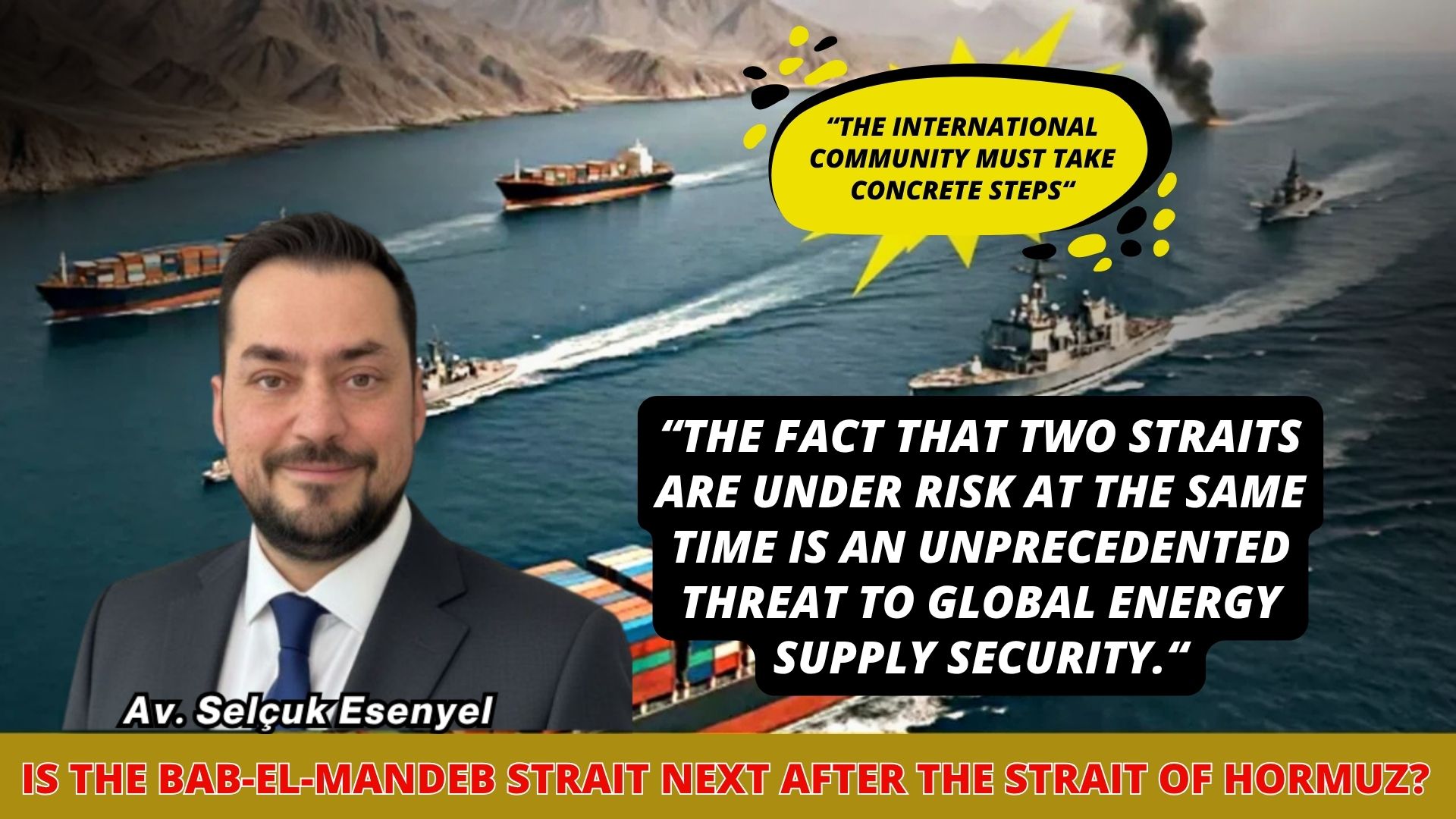
Following the Houthi missile attack from Yemen toward Israel, international attention has shifted to the Bab-el-Mandeb Strait at a time of rising tensions in the Strait of Hormuz. Highlighting that a total closure of the Strait of Hormuz would be unlawful, Selçuk Esenyel, Founding Partner of Esenyel & Partners and Maritime Law Expert, stated the following regarding the Bab-el-Mandeb Strait:
The blockade in Hormuz was already a major crisis in itself. Now, looking at Bab-el-Mandeb, the Houthis are firing missiles at Israel, turning that narrow passage into a second crisis point. This means commercial vessels are currently at risk in two critical straits simultaneously. The fact that both straits are under threat at the same time is an unprecedented menace to global energy supply security. Therefore, the international community must take concrete steps; there is no longer the luxury of waiting.
Developments in the Strait of Hormuz over recent weeks point to a critical period for global energy security, particularly due to escalating conflict between the US-Israel and Iran. Following Iran’s announcement that ships heading to US-Israeli ports or those associated with these countries would not be allowed to pass through the Strait of Hormuz, the number of vessels passing through the strait dropped dramatically in March, and on some days, shipments almost came to a standstill. This reduction created global pressure on the energy supply chain. Disruptions in Hormuz threaten not only oil but also fertilizer supplies and agricultural production chains. This situation creates a new risk for global food prices. The Iranian Revolutionary Guard’s announcement on March 27 that the Strait of Hormuz was completely closed significantly raised regional tensions. However, the actual situation appears more complex than the declared closure; in the March 2026 documents of the IMO, the term “purported closure” was used, reporting that Iran allowed passage for some “non-hostile” vessels. Therefore, legally, the more accurate term is not a “total closure” but rather a selective, threat-based, and effectively stalling “interdiction regime”.
Finally, the direct involvement of the Houthis in Yemen in the conflict process starting February 28 with missile attacks on Israel turned international attention toward the Bab-el-Mandeb Strait during this period of tension in Hormuz. According to US Energy Information Administration (EIA) data, approximately 10% of global oil trade transported by sea is provided through this narrow passage.
Evaluating the latest developments in the region, Maritime Law Expert Selçuk Esenyel stated:
Now everyone is asking: Can Iran close the strait? It is a question that sounds simple, but the truth is extremely complex from a legal perspective. Article 38 of UNCLOS recognizes the right of transit passage in international straits. However, Iran signed this convention in 1982 but did not ratify it. More importantly, it has persistently objected to the transit passage regime since the negotiation process. Iran’s thesis is this: Only ‘innocent passage’ is valid in Hormuz. In international law, this is called the ‘persistent objector’ doctrine. The International Court of Justice confirmed this in the 1951 Anglo-Norwegian Fisheries Case: A state that consistently objects to a customary rule while it is being formed cannot be bound by that rule. This is a serious argument that Iran can put forward, I admit. But there are equally strong arguments on the other side. First, Iran has de facto allowed transit passage through this strait for decades. Jurists call this ‘tacit acceptance’, which weakens the status of a persistent objector. Second, the 1949 Corfu Channel Case confirmed the right of passage through international straits long before UNCLOS. Therefore, the debate continues on whether transit passage is a new rule created by UNCLOS or the codification of an existing custom. But the issue is not just that. One must also see this: Since February 28, there has been a de facto war between Iran and the US-Israel. This is an international armed conflict between states. In this case, the law of war comes into play. As a party to a war, Iran can declare a naval blockade, stop neutral ships, search them, and seize enemy cargo. These are rights a sovereign state possesses in a state of war. However, and this is very important, even these rights are not unlimited. The San Remo Manual, while not a binding treaty, largely reflects customary law. According to San Remo, a blockade must be notified, effectively applied, applied impartially, not cause disproportionate harm to neutral states, and humanitarian passage must be ensured. The fact that Iran allows passage to some ‘non-hostile’ vessels shows it is actually applying a selective blockade regime. Does this regime meet San Remo conditions? There are serious question marks, especially regarding not obstructing access to neutral ports and proportionality. Whether viewed from the perspective of peacetime maritime law or the law of war, it cannot be argued that Iran has the right to close the strait completely and indiscriminately.
Explaining the difference between innocent passage and transit passage, Esenyel said:
There is a very fundamental distinction here. The coastal state cannot suspend the right of transit passage; UNCLOS Article 44 clearly states this. In innocent passage, however, the coastal state has limited authority: according to Article 25/3, it can suspend it temporarily and in a limited manner for specific areas. So, it is temporary and local, that’s it. What does Iran say? ‘Transit passage is not valid here; only innocent passage is.’ Fine, let’s assume we accept this thesis. Even then, it cannot implement an indefinite and general closure because Article 25/3 does not allow it. On the other hand, the vast majority of the international community accepts that Hormuz has the status of an international strait and that the transit passage regime should be applied. In that case, Article 44 is valid, and you cannot obstruct passage. Therefore, whichever way you look at it, the total and indefinite closure of the strait is unlawful under both regimes.
As the attacks launched by the US and Israel against Iran on February 28 enter their 4th week, sharp fluctuations in energy prices in global markets continue. Stating that the blockage on this route brings the concept of force majeure to the agenda, Esenyel said:
Force majeure is on everyone’s lips, but the truth of the matter is not that simple. First, you need to ask: Is there a force majeure clause in your contract? Which law applies? Does the event truly make performance impossible, or does it just make it more expensive? Have you fulfilled your notification obligation? What have you done to mitigate the loss? You cannot say ‘there is force majeure’ without answering all of these. The ICC’s 2020 Force Majeure and Hardship Clauses are a good model as a guide, but they are not binding law; they must be explicitly included in the contract. One must also not forget that ‘frustration’ in English law produces different results than ‘force majeure’ in Turkish law or Continental European law. Therefore, each contract must be analyzed individually. On the insurance side, war risk clauses will certainly be triggered; we can count on that.
The fact that two straits are under risk at the same time is an unprecedented threat to global energy supply security.
Speaking about the Bab-el-Mandeb Strait, to which international attention turned after the Houthi missile attack on Israel, Esenyel said:
Bab-el-Mandeb, like Hormuz, is an international strait under UNCLOS Article 37, and the transit passage regime applies. But the picture here is very different from Hormuz. In Hormuz, there is a sovereign state, a party to the war, and its belligerent rights are undisputed. In Bab-el-Mandeb, there are the Houthis. The Houthis declared war, true. But in international law, the nature of a conflict depends on the factual situation, not what you declare. The ICRC states this clearly. A conflict between states is an IAC (International Armed Conflict). A conflict between a state and an armed group is a NIAC (Non-International Armed Conflict). The Houthis control territory, yes. But the international community recognizes the Presidential Leadership Council as the legitimate government of Yemen. This is a very important distinction. Because in the law of naval warfare, belligerent rights such as declaring a blockade, stopping neutral ships, and seizing enemy cargo are essentially valid in the context of an IAC. An armed group declaring war does not automatically grant it belligerent rights over commercial vessels. The issue of threshold here is not the declaration of war, but the classification of the conflict and state attribution. The San Remo Manual is a frequently cited resource on this subject, but it imposes strict conditions, such as notifying the blockade and not obstructing access to the coasts of neutral states. The Houthis are attacking commercial ships flying neutral flags indiscriminately without declaring an official blockade. From whichever framework you look at it, this is a violation of the principles of distinction and proportionality. UN Security Council Resolution 2216 provides for an arms embargo on the Houthis, but that is a 2015 resolution and is insufficient for the current scale of the crisis. Recent UN and IMO decisions must be closely followed. When we look at the energy dimension, approximately 9% of global maritime oil trade passes through Bab-el-Mandeb. Now some people add this to the 20% in Hormuz and say ‘one-third is at risk’, but this is not correct. Since oil going from the Persian Gulf to Europe passes through both straits, a simple addition creates double counting. But what is certain is that both straits being under risk at the same time is an unprecedented threat to global energy supply security. Coastal states, primarily Yemen, Djibouti, and Eritrea, have an obligation not to obstruct transit passage under UNCLOS Article 44. IMO resolutions condemning attacks on commercial ships and SOLAS provisions are in place. Protecting these ships is the collective responsibility of the international community; no one can escape this.
Your personal data; protecting the privacy of visitors to the website (www.esenyelpartners.com), operated by Company Name (“COMPANY” or “Esenyel Partners” as it will be referred to), as the data controller, is one of the leading principles of our Institution. This Cookie Usage Policy (“GDPR”) explains to all our website visitors and users under what conditions and which types of cookies are used.
Cookies are small text files stored on your device or network server by the websites you visit via your computer or mobile device.
They are generally used to provide you with a personalized experience while using the website, improve the services offered, enhance your experience, and contribute to ease of use while navigating a website. If you do not prefer the use of cookies, you can delete or block cookies from your browser settings. However, we would like to remind you that this may affect your use of our website. Unless you change your cookie settings from your browser, we will assume that you accept the use of cookies on this site.
Depending on the type of cookies used on websites, data regarding your browsing and usage preferences on the device from which you visit the site is collected. This data includes information about the pages you access, the services and products you review, your preferred language selection, and other preferences.
Cookies are small text files stored on your device or network server by websites you visit via browsers. These small text files containing your preferred language and other settings help remember your preferences on your next visit and enable us to improve our services to enhance your experience on the site. Thus, you can have a better and more personalized user experience on your next visit.
The primary purposes of using cookies on our website are listed below:
Session cookies ensure the proper functioning of the website during your visit. They are used for purposes such as ensuring the security and continuity of our sites and your visit. Session cookies are temporary cookies that are deleted when you close your browser and revisit our site; they are not permanent.
These types of cookies are used to remember your preferences and are stored on your device via browsers. Persistent cookies remain even after you close your browser or restart your computer. These cookies are stored in the subfolders of your browser until they are deleted from your browser settings.
Certain types of persistent cookies can be used to provide personalized recommendations based on factors such as the purpose of your use of the website.
Thanks to persistent cookies, when you revisit our website with the same device, it checks whether a cookie previously created by our website exists on your device. If it does, it is understood that you have visited the site before, and the content presented to you is determined accordingly, providing you with better service.
These are cookies necessary for the proper functioning of the website you visit. The purpose of these cookies is to provide the required services by ensuring the functionality of the site. For example, they allow access to secure areas of the website, enable you to use its features, and facilitate navigation.
These cookies collect information about how the website is used, the frequency and number of visits, and how visitors access the site. The purpose of using these cookies is to improve the functioning of the site by enhancing its performance and determining the general trend direction. They do not contain data that can identify visitor identities. For example, they indicate the number of error messages displayed or the most frequently visited pages.
These cookies remember the selections made by visitors on the site for their next visit. The purpose of these cookies is to provide convenience to visitors. For example, they prevent the user from having to re-enter their password on each page they visit.
These cookies measure the effectiveness of the ads presented to visitors and track how many times an ad is displayed. The purpose of these cookies is to provide visitors with advertisements tailored to their interests.
Similarly, they identify visitors’ areas of interest based on their browsing activities and present appropriate content. For example, they prevent an advertisement shown to a visitor from being displayed again in a short period.
To change your preferences regarding the use of cookies or to block or delete cookies, you need to change your browser settings.
Many browsers allow you to control cookies by offering options to accept or reject cookies, accept only certain types of cookies, or be notified when a website requests to store cookies on your device.
It is also possible to delete previously stored cookies in your browser.
If you disable or reject cookies, you may need to manually adjust some preferences, and some features and services on the website may not function properly because we will not be able to recognize and associate your account. You can change your browser settings by clicking the relevant link in the table below.
The Website Privacy Policy is dated 10/10/2024. If the entire policy or specific articles are updated, the effective date of the policy will be updated accordingly. The Privacy Policy is published on the Institution’s website (www.esenyelpartners.com) and is made available to personal data owners upon request.
Company Name: Esenyel Partners
Address: Levent Mah. Sümbül Sok. No: 61 34330 Beşiktaş, Istanbul – Turkey
Phone: +90 506 792 7690
E-Mail: info@esenyelpartners.com
Website: www.esenyelpartners.com