
27 Oct, 2026
Information Note on the Communiqué on Extending the Deadline for Joint-Stock and Limited Liability Companies to Increase Their Capital to the New Minimum Amounts
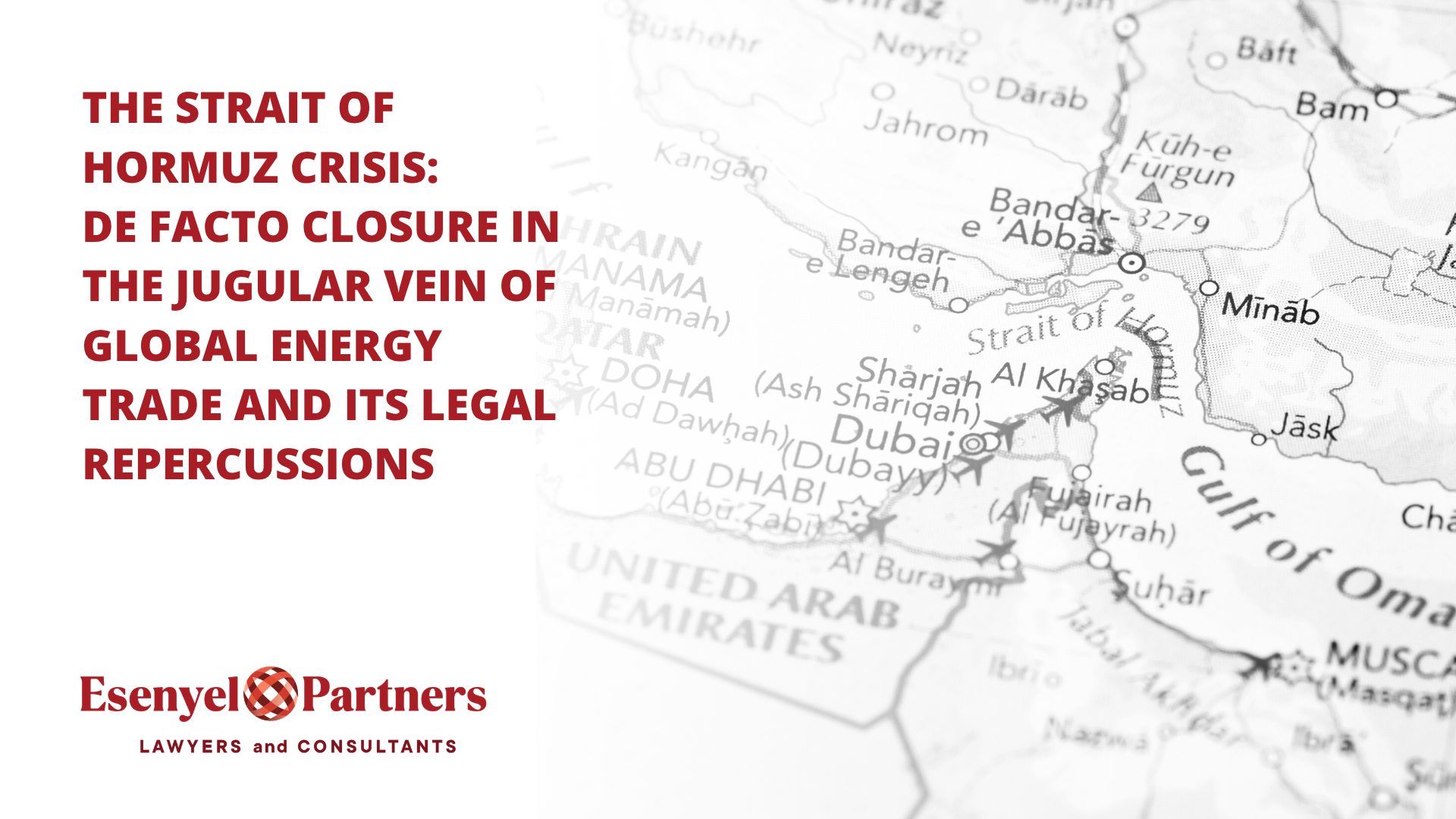
The Strait of Hormuz, as the most critical transit point of global energy trade, is a massive strategic vein through which approximately 20 million barrels of oil and one-fifth of the global LNG trade flow daily. The coordinated military operation by the United States and Israeli armed forces against Iran on February 28, 2026, ignited an unprecedented crisis in the global maritime and energy markets. The Strait of Hormuz crisis, with the retaliation actions of the Islamic Revolutionary Guard Corps (IRGC) targeting maritime traffic in the Persian Gulf and especially in the strait, has turned the region into a de facto war zone in terms of commercial navigation and deeply shaken the dynamics of international maritime trade law.
The IRGC’s declaration of officially closing the strait to commercial transit on March 2, along with drone and missile attacks targeting ports and ships in the region, has reduced maritime traffic to almost zero. According to data from the analytics firm Kpler, traffic in the strait has plummeted by up to 90 percent; more than 150 tankers are anchored off the Gulf of Oman, awaiting updates on the latest situation of ship passage through the Strait of Hormuz and the possibility of safe transit. While Brent crude oil prices have exceeded $120, prices at the Dutch TTF, the European natural gas market hub, have doubled compared to the pre-crisis period.
Under the United Nations Convention on the Law of the Sea (UNCLOS), the regime of “Transit Passage” applies to straits open to international navigation, such as Hormuz. This regime does not grant coastal states the right to impede the passage of ships. Iran’s claim to apply the rules of “Innocent Passage” is incompatible with the fundamental principles of international maritime law; there is no strong legal basis for the unilateral closure of the strait.
However, the legal status and the commercial reality on the ground are rapidly diverging. Security risks in the region have led the market to make its own assessment without waiting for political decisions. The refusal of shipowners to send ships to the region in order not to endanger their assets and crew means a “de facto closure” even if the strait is legally open. In international markets, this picture is referred to as an “insurance-driven closure”: when insurers refuse to provide coverage, shipowners cannot risk the passage.
In international maritime trade, contracts of carriage and charterparty agreements are mostly subject to the rules of English maritime law. Unlike continental European systems, English law does not recognize the concept of force majeure as an independent legal principle; this concept can only be invoked if it is explicitly regulated in the contract. For parties without such a provision in their contract, the only option is the doctrine of frustration under English law, the acceptance of which is extremely difficult in practice. This legal framework constitutes one of the core areas of expertise of Esenyel Partners since its establishment. Charterparty disputes subject to English maritime trade law, LMAA arbitration proceedings, and coordinated case management conducted with London-based law firms are an integral part of our team’s daily practice.
In the contracts regulating the relationship between the shipowner using their vessel in maritime trade and the carrier undertaking the carriage of the cargo, the points that must be examined most carefully today are as follows:
While standard Hull and Machinery (H&M) and Protection and Indemnity (P&I) club insurances cover ordinary risks, entering regions like Hormuz triggers marine insurance war risk clauses. The JWC has expanded the definition of the high-risk area to include the territorial waters of Oman. As of March 5, P&I coverage for the region has been largely suspended; insurers are demanding exorbitant Additional Premiums (AP). Legally, although insurance companies do not have the right to arbitrarily withdraw from the policy, deviation or war risk exceptions in the policy texts allow for the narrowing of coverage. With reinsurance companies losing their risk appetite, finding coverage for the region becomes entirely impossible. Esenyel Partners closely manages the legal processes between shipowners and insurers in war risk coverage and policy scope disputes, within the framework of long-standing cooperation with world-renowned P&I clubs and insurance companies.
For Turkey, the biggest short-term risk of the crisis is the inflationary pressure on industrial inputs caused by the increase in energy import costs. The T.R. Ministry of Transport and Infrastructure has raised the ISPS Code Security Level to 3, the highest level, for Turkish-flagged ships navigating in the region; instant tracking of NAVTEX warnings and continuous contact with AAKKM (Main Search and Rescue Coordination Center) have been made mandatory. On the other hand, this crisis paves the way for Turkey to rise again to the role of a critical energy corridor for Europe with strategic pipelines such as TANAP and TurkStream.
As Esenyel Partners, we are closely monitoring the legal and operational risks emerging in this complex process. The tension in the Strait of Hormuz and the legal confusion it brings oblige industry stakeholders to review their contract structures and operational protocols. The correct interpretation of war risk and force majeure clauses within the scope of charterparty agreements under English maritime law, the matching of coverage scope in insurance policies with the current risk map, and the clear determination of the contractual distribution of waiting costs are the fundamental keys to surviving such extraordinary crisis periods with minimum damage. As Esenyel Partners, we are always by your side on these issues under the leadership of Atty. Selçuk Sencer Esenyel and Atty. M. Türker Yıldırım.
Your personal data; protecting the privacy of visitors to the website (www.esenyelpartners.com), operated by Company Name (“COMPANY” or “Esenyel Partners” as it will be referred to), as the data controller, is one of the leading principles of our Institution. This Cookie Usage Policy (“GDPR”) explains to all our website visitors and users under what conditions and which types of cookies are used.
Cookies are small text files stored on your device or network server by the websites you visit via your computer or mobile device.
They are generally used to provide you with a personalized experience while using the website, improve the services offered, enhance your experience, and contribute to ease of use while navigating a website. If you do not prefer the use of cookies, you can delete or block cookies from your browser settings. However, we would like to remind you that this may affect your use of our website. Unless you change your cookie settings from your browser, we will assume that you accept the use of cookies on this site.
Depending on the type of cookies used on websites, data regarding your browsing and usage preferences on the device from which you visit the site is collected. This data includes information about the pages you access, the services and products you review, your preferred language selection, and other preferences.
Cookies are small text files stored on your device or network server by websites you visit via browsers. These small text files containing your preferred language and other settings help remember your preferences on your next visit and enable us to improve our services to enhance your experience on the site. Thus, you can have a better and more personalized user experience on your next visit.
The primary purposes of using cookies on our website are listed below:
Session cookies ensure the proper functioning of the website during your visit. They are used for purposes such as ensuring the security and continuity of our sites and your visit. Session cookies are temporary cookies that are deleted when you close your browser and revisit our site; they are not permanent.
These types of cookies are used to remember your preferences and are stored on your device via browsers. Persistent cookies remain even after you close your browser or restart your computer. These cookies are stored in the subfolders of your browser until they are deleted from your browser settings.
Certain types of persistent cookies can be used to provide personalized recommendations based on factors such as the purpose of your use of the website.
Thanks to persistent cookies, when you revisit our website with the same device, it checks whether a cookie previously created by our website exists on your device. If it does, it is understood that you have visited the site before, and the content presented to you is determined accordingly, providing you with better service.
These are cookies necessary for the proper functioning of the website you visit. The purpose of these cookies is to provide the required services by ensuring the functionality of the site. For example, they allow access to secure areas of the website, enable you to use its features, and facilitate navigation.
These cookies collect information about how the website is used, the frequency and number of visits, and how visitors access the site. The purpose of using these cookies is to improve the functioning of the site by enhancing its performance and determining the general trend direction. They do not contain data that can identify visitor identities. For example, they indicate the number of error messages displayed or the most frequently visited pages.
These cookies remember the selections made by visitors on the site for their next visit. The purpose of these cookies is to provide convenience to visitors. For example, they prevent the user from having to re-enter their password on each page they visit.
These cookies measure the effectiveness of the ads presented to visitors and track how many times an ad is displayed. The purpose of these cookies is to provide visitors with advertisements tailored to their interests.
Similarly, they identify visitors’ areas of interest based on their browsing activities and present appropriate content. For example, they prevent an advertisement shown to a visitor from being displayed again in a short period.
To change your preferences regarding the use of cookies or to block or delete cookies, you need to change your browser settings.
Many browsers allow you to control cookies by offering options to accept or reject cookies, accept only certain types of cookies, or be notified when a website requests to store cookies on your device.
It is also possible to delete previously stored cookies in your browser.
If you disable or reject cookies, you may need to manually adjust some preferences, and some features and services on the website may not function properly because we will not be able to recognize and associate your account. You can change your browser settings by clicking the relevant link in the table below.
The Website Privacy Policy is dated 10/10/2024. If the entire policy or specific articles are updated, the effective date of the policy will be updated accordingly. The Privacy Policy is published on the Institution’s website (www.esenyelpartners.com) and is made available to personal data owners upon request.
Company Name: Esenyel Partners
Address: Levent Mah. Sümbül Sok. No: 61 34330 Beşiktaş, Istanbul – Turkey
Phone: +90 506 792 7690
E-Mail: info@esenyelpartners.com
Website: www.esenyelpartners.com