
03 Sep, 2026
Public Announcement
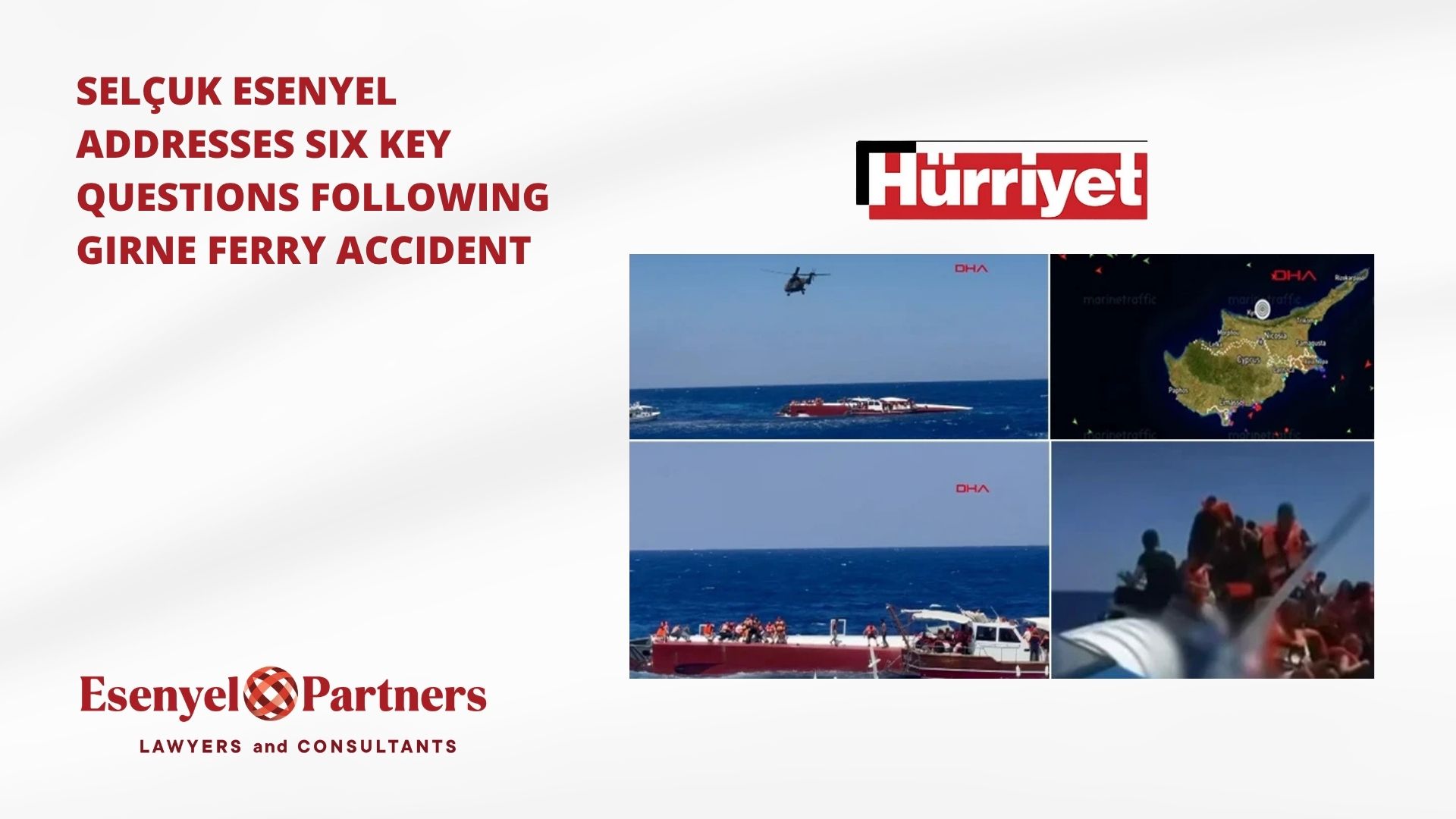
Hürriyet put six critical questions of public concern to Selçuk Esenyel, Founding and Managing Partner of Esenyel Partners, about the passenger vessel that began taking on water and capsized shortly after leaving Girne Port for Taşucu Port in Mersin. From the perspective of maritime law, Esenyel answered questions ranging from who might bear responsibility for the accident and the vessel’s technical safety to the evacuation and the rights of affected passengers.
Esenyel’s assessment emphasized that no single person or organization could be held definitively responsible before the investigation was complete and that the technical findings, maintenance and navigation records, carriage relationship, and chronology of the incident all had to be examined together.
Selçuk Esenyel stated that responsibility for the accident could not be assessed solely by reference to the master or a single operator. The respective roles of the carrier, performing carrier, master, crew, and those involved in maintenance and inspection had to be examined separately. He added that criminal liability and civil liability, including liability in damages, might be governed by different principles.
Esenyel explained that class and insurance certificates, safety management, crew qualifications, life-saving appliances, communication systems, and maintenance records were important parts of the investigation. Valid documentation alone, however, would not be sufficient: the vessel’s actual safety condition on the day of the incident would also have to be established through technical findings.
Esenyel said that the vessel’s ingress of water did not, by itself, establish negligence. No firm conclusion could be reached without examining the point of ingress, the condition of the hull, watertight compartments, pumps, alarms, stability calculations, and maintenance history. He noted, however, that sailing without correcting a defect that was known or discoverable on a reasonable inspection could be relevant to liability.
Selçuk Esenyel explained that purchasing a ticket created a contract for the carriage of a passenger by sea and that the carriage relationship included an obligation to provide safe passage. The company named on the ticket might differ from the party actually operating the vessel, but this would not in itself discharge the contractual carrier from liability.
According to Esenyel, the evacuation could be reconstructed minute by minute from voyage data recorder (VDR) and automatic identification system (AIS) data, radio communications, logbooks, alarm data, camera footage, and the timing of the distress call. Allegations about announcements to passengers, directions from the crew, access to lifejackets, and use of rescue craft would also have to be assessed against documentary records and witness accounts.
Selçuk Esenyel stated that injured passengers might bring claims for medical expenses, loss of earning capacity, permanent disability, and other pecuniary losses and, depending on the circumstances, for non-pecuniary damages. The applicable law and the party against whom a claim should be brought would be determined by reference to the contract of carriage, route, and connecting factors of the incident. He also stressed the importance of preserving medical reports, tickets, and records evidencing loss.
The common thread in Selçuk Esenyel’s answers to Hürriyet is that liability for a marine casualty cannot be determined conclusively from the initial assessments made immediately afterwards. A sound conclusion requires both the technical investigations and the legal relationships among the carrier, performing carrier, ship operator, master, and crew to be considered together.
Esenyel’s comments show that, when determining the cause of the accident and allocating responsibility, the vessel’s actual safety condition at the time and the records of the evacuation will be as decisive as its documentation on paper.
You can read all of Selçuk Esenyel’s answers to the six critical questions about the Girne ship accident in Hürriyet’s report.
Your personal data; protecting the privacy of visitors to the website (www.esenyelpartners.com), operated by Company Name (“COMPANY” or “Esenyel Partners” as it will be referred to), as the data controller, is one of the leading principles of our Institution. This Cookie Usage Policy (“GDPR”) explains to all our website visitors and users under what conditions and which types of cookies are used.
Cookies are small text files stored on your device or network server by the websites you visit via your computer or mobile device.
They are generally used to provide you with a personalized experience while using the website, improve the services offered, enhance your experience, and contribute to ease of use while navigating a website. If you do not prefer the use of cookies, you can delete or block cookies from your browser settings. However, we would like to remind you that this may affect your use of our website. Unless you change your cookie settings from your browser, we will assume that you accept the use of cookies on this site.
Depending on the type of cookies used on websites, data regarding your browsing and usage preferences on the device from which you visit the site is collected. This data includes information about the pages you access, the services and products you review, your preferred language selection, and other preferences.
Cookies are small text files stored on your device or network server by websites you visit via browsers. These small text files containing your preferred language and other settings help remember your preferences on your next visit and enable us to improve our services to enhance your experience on the site. Thus, you can have a better and more personalized user experience on your next visit.
The primary purposes of using cookies on our website are listed below:
Session cookies ensure the proper functioning of the website during your visit. They are used for purposes such as ensuring the security and continuity of our sites and your visit. Session cookies are temporary cookies that are deleted when you close your browser and revisit our site; they are not permanent.
These types of cookies are used to remember your preferences and are stored on your device via browsers. Persistent cookies remain even after you close your browser or restart your computer. These cookies are stored in the subfolders of your browser until they are deleted from your browser settings.
Certain types of persistent cookies can be used to provide personalized recommendations based on factors such as the purpose of your use of the website.
Thanks to persistent cookies, when you revisit our website with the same device, it checks whether a cookie previously created by our website exists on your device. If it does, it is understood that you have visited the site before, and the content presented to you is determined accordingly, providing you with better service.
These are cookies necessary for the proper functioning of the website you visit. The purpose of these cookies is to provide the required services by ensuring the functionality of the site. For example, they allow access to secure areas of the website, enable you to use its features, and facilitate navigation.
These cookies collect information about how the website is used, the frequency and number of visits, and how visitors access the site. The purpose of using these cookies is to improve the functioning of the site by enhancing its performance and determining the general trend direction. They do not contain data that can identify visitor identities. For example, they indicate the number of error messages displayed or the most frequently visited pages.
These cookies remember the selections made by visitors on the site for their next visit. The purpose of these cookies is to provide convenience to visitors. For example, they prevent the user from having to re-enter their password on each page they visit.
These cookies measure the effectiveness of the ads presented to visitors and track how many times an ad is displayed. The purpose of these cookies is to provide visitors with advertisements tailored to their interests.
Similarly, they identify visitors’ areas of interest based on their browsing activities and present appropriate content. For example, they prevent an advertisement shown to a visitor from being displayed again in a short period.
To change your preferences regarding the use of cookies or to block or delete cookies, you need to change your browser settings.
Many browsers allow you to control cookies by offering options to accept or reject cookies, accept only certain types of cookies, or be notified when a website requests to store cookies on your device.
It is also possible to delete previously stored cookies in your browser.
If you disable or reject cookies, you may need to manually adjust some preferences, and some features and services on the website may not function properly because we will not be able to recognize and associate your account. You can change your browser settings by clicking the relevant link in the table below.
The Website Privacy Policy is dated 10/10/2024. If the entire policy or specific articles are updated, the effective date of the policy will be updated accordingly. The Privacy Policy is published on the Institution’s website (www.esenyelpartners.com) and is made available to personal data owners upon request.
Company Name: Esenyel Partners
Address: Levent Mah. Sümbül Sok. No: 61 34330 Beşiktaş, Istanbul – Turkey
Phone: +90 506 792 7690
E-Mail: info@esenyelpartners.com
Website: www.esenyelpartners.com