
30 Sep, 2026
Maritime Compliance Alert: Strict Enforcement on Cross-Border Cruising Between Kuşadası and Samos
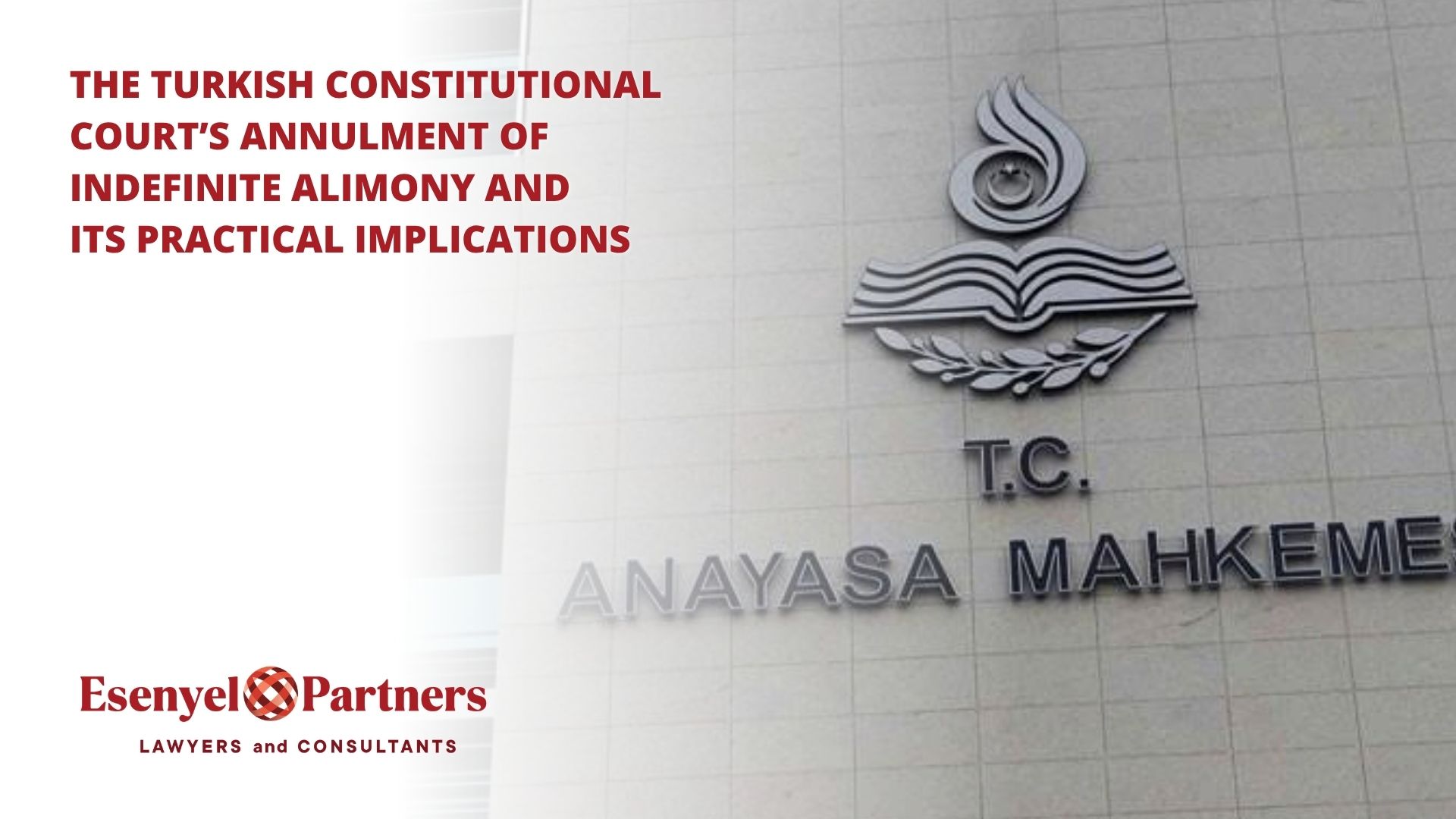
By its decision dated 4 June 2026 (Case No. 2025/156, Decision No. 2026/131), the Turkish Constitutional Court (the Constitutional Court) found the phrase ‘indefinitely’ in the first paragraph of Article 175 of the Turkish Civil Code No. 4721 (the TCC), the provision governing poverty alimony, to be unconstitutional and annulled it. The decision was published in Official Gazette No. 33386 of 30 September 2026, and the annulment will enter into force nine months after its publication, on 30 June 2027.
The decision, which concerns a provision long debated in Türkiye under the heading of ‘indefinite alimony’, does not abolish poverty alimony. By preventing alimony from being awarded indefinitely in every case, it requires a predictable legal framework under which the duration of alimony can be determined according to the particular circumstances of each case.
Poverty alimony, which aims to protect the spouse who would be left in financial hardship as a result of divorce, is regulated under Article 175 of the TCC. Accordingly, a party who would fall into poverty due to divorce may claim alimony for an indefinite period from the other party for their subsistence, in proportion to the other party’s financial means, provided that they are not more at fault than the other party; the fault of the alimony debtor is not required. A spouse who would fall into poverty due to the divorce may therefore claim this alimony if they are equally at fault, less at fault, or not at fault. According to the settled case law of the Court of Cassation, a person whose income is insufficient to cover essential needs such as food, clothing, housing, healthcare, transportation, culture, and education is considered to be in poverty.
Under the original version of Article 144 of the repealed Turkish Civil Code No. 743, poverty alimony was limited to one year; this limit was removed by an amendment introduced by Law No. 3444 in 1988, allowing alimony to be claimed indefinitely, and this approach was retained in the TCC with simplified wording.
In practice, the term ‘indefinite alimony’ is perceived as meaning that the alimony obligation continues for life under all circumstances, and this perception gives rise to significant disputes between the parties. However, under Article 176 of the TCC, alimony paid in periodic instalments terminates automatically upon the remarriage of the alimony creditor or the death of either party, and is terminated by court order if the creditor cohabits with another person as if married without marrying, ceases to be in poverty, or leads a dishonourable life. Alimony may also be increased or reduced where the financial circumstances of the parties change or where equity so requires.
Indeed, in its decision dated 17 May 2012 (Case No. 2011/136, Decision No. 2012/72), the Constitutional Court held that the element of indefiniteness does not mean that the alimony creditor will receive alimony for life under all circumstances, and did not find the same phrase unconstitutional. However, settled judicial practice has held that judges have no discretion as to the duration of alimony and that limiting alimony to a specific period is contrary to the law (Court of Cassation, 2nd Civil Chamber, 12 December 2017, Case No. 2016/8859, Decision No. 2017/14407). Likewise, in the practice of the Court of Cassation, the fact that the alimony creditor earns an income at minimum-wage level does not, as a rule, by itself end their poverty, but is taken into account in determining the amount of alimony. Consequently, unless one of the circumstances listed in the law occurs, the alimony obligation may in practice last for life.
In its review upon the referral made by the Antalya 12th Family Court, the Constitutional Court also examined the rule under Articles 5 and 17 of the Constitution, which it considered relevant. The Court first found that, although the wording of the rule allows indefinite alimony, it does not require indefinite alimony to be awarded in every case, whereas settled judicial practice has interpreted the rule as mandatory; the rule therefore cannot be regarded as sufficiently clear and precise to leave no room for doubt.
The core of the decision, however, is the fair balance assessment under Articles 5 and 17 of the Constitution. According to the Court, the State has a positive obligation to strike a fair balance between the conflicting interests of the alimony creditor and the alimony debtor. Providing for poverty alimony categorically for an indefinite period without any criteria imposes a heavy burden on the alimony debtor, who need not even be at fault; the debtor remaining bound by the consequences of the marriage for life adversely affects their psychological, economic, and social integrity and eliminates the reasonable balance between the parties.
The decision also noted that there is no single model in comparative law. For instance, in Switzerland the amount and duration of alimony are determined according to the circumstances of each case. In the Netherlands, where the court does not set a different period, alimony is, as a rule, limited to half the duration of the marriage and to a maximum of five years, with different maximum periods for long marriages and where the spouses have children together; in Belgium, alimony may not, as a rule, exceed the duration of the marriage, but it may be extended if the need persists.
According to the Constitutional Court, criteria such as the duration of the marriage, the age and health of the spouses, their economic and social circumstances, the possibility of participating in working life, the impact of the duration of alimony on the debtor’s post-divorce life, and the alimony creditor’s education and capacity to meet their economic needs through their own means should be taken into account in determining the duration of alimony. In the Court’s view, the State’s duty to strike a fair balance means that poverty alimony should, as a rule, be capable of being limited to a period appropriate to the circumstances, while it should also be possible to extend the period in favour of the creditor and to award lifetime alimony where certain conditions are met; in addition, the criteria for cases requiring indefinite alimony must be set out clearly and precisely in the law. On these grounds, the rule was found to be contrary to Articles 2, 5, and 17 of the Constitution and was annulled by majority vote.
The dissenting opinion stated that need, not time, lies at the heart of poverty alimony, that Article 176 of the TCC provides sufficient tools for the reduction and revocation of alimony, and that the problems encountered in practice stem not from the rule itself but from its rigid interpretation. The dissent also emphasized that protecting the spouse who becomes economically vulnerable after divorce is consistent with the understanding of substantive equality under Article 10 of the Constitution and with the Convention on the Elimination of All Forms of Discrimination against Women (CEDAW), to which Türkiye is a party.
Considering that the legal gap arising from the annulment would be of a nature to harm the public interest, the Constitutional Court unanimously decided that the annulment would enter into force nine months after the publication of the decision in the Official Gazette. Accordingly, the annulment will take effect on 30 June 2027, and Article 175 of the TCC will continue to apply in its current form until that date.
According to public statements, the new regulation on poverty alimony is expected to be submitted to the Grand National Assembly of Türkiye (the Parliament) in October 2026 as part of a judicial reform package. Although, according to press reports, the models under discussion in the draft work include determining the duration of alimony on a graduated basis linked to the length of the marriage and allowing judges to extend the period for elderly persons or those in need of care, as of the date of this newsletter no bill has been submitted to Parliament. The phrase ‘indefinitely’ will cease to have effect on 30 June 2027 in any event; if no new regulation is enacted by that date, the duration of alimony may have to be determined by the courts in light of the criteria set out in the decision.
Since annulment decisions do not have retroactive effect under Article 153 of the Constitution, existing poverty alimony awarded by final judgments will not terminate automatically as a result of the decision. Whether existing alimony will be affected by the new regulation will depend primarily on the transitional provisions to be adopted by the legislature; at this stage, the revocation or reduction of existing alimony may only be requested on the grounds set out in Article 176 of the TCC.
In pending divorce proceedings, the current provision will apply until 30 June 2027; in cases that have not become final by that date, the annulment decision, the new regulation, and any transitional provisions may need to be taken into account. It should also be noted that the decision concerns only the duration of poverty alimony; interim alimony, child support for the parties’ children, and maintenance payable to relatives in need fall outside its scope.
While the Constitutional Court’s decision does not abolish poverty alimony, it paves the way for a shift from the current system, in which alimony is categorically awarded for an indefinite period, to a model in which its duration is determined according to the circumstances of each case and on the basis of predictable criteria. The content of the new regulation, in particular the criteria for determining the duration of alimony, the treatment of exceptional situations such as long marriages, advanced age, and health problems, and the transitional provisions for existing alimony, will be decisive for both alimony creditors and alimony debtors. In the meantime, it is important that the strategy in pending divorce cases and existing alimony arrangements be assessed on a case-by-case basis while closely monitoring legislative developments.
| Selçuk Esenyel Founding and Managing Partner Tel: +90 212 397 19 91 Mob: +90 506 792 76 90 | Semih Sander Partner semih.sander@esenyelpartners.com Tel: +90 212 397 19 91 Mob: +90 532 590 92 32 |
| Burcu Tuna Ayna Team Leader burcu.tuna@esenyelpartners.com Tel: +90 212 397 19 91 Mob: +90 530 914 66 29 | |
Your personal data; protecting the privacy of visitors to the website (www.esenyelpartners.com), operated by Company Name (“COMPANY” or “Esenyel Partners” as it will be referred to), as the data controller, is one of the leading principles of our Institution. This Cookie Usage Policy (“GDPR”) explains to all our website visitors and users under what conditions and which types of cookies are used.
Cookies are small text files stored on your device or network server by the websites you visit via your computer or mobile device.
They are generally used to provide you with a personalized experience while using the website, improve the services offered, enhance your experience, and contribute to ease of use while navigating a website. If you do not prefer the use of cookies, you can delete or block cookies from your browser settings. However, we would like to remind you that this may affect your use of our website. Unless you change your cookie settings from your browser, we will assume that you accept the use of cookies on this site.
Depending on the type of cookies used on websites, data regarding your browsing and usage preferences on the device from which you visit the site is collected. This data includes information about the pages you access, the services and products you review, your preferred language selection, and other preferences.
Cookies are small text files stored on your device or network server by websites you visit via browsers. These small text files containing your preferred language and other settings help remember your preferences on your next visit and enable us to improve our services to enhance your experience on the site. Thus, you can have a better and more personalized user experience on your next visit.
The primary purposes of using cookies on our website are listed below:
Session cookies ensure the proper functioning of the website during your visit. They are used for purposes such as ensuring the security and continuity of our sites and your visit. Session cookies are temporary cookies that are deleted when you close your browser and revisit our site; they are not permanent.
These types of cookies are used to remember your preferences and are stored on your device via browsers. Persistent cookies remain even after you close your browser or restart your computer. These cookies are stored in the subfolders of your browser until they are deleted from your browser settings.
Certain types of persistent cookies can be used to provide personalized recommendations based on factors such as the purpose of your use of the website.
Thanks to persistent cookies, when you revisit our website with the same device, it checks whether a cookie previously created by our website exists on your device. If it does, it is understood that you have visited the site before, and the content presented to you is determined accordingly, providing you with better service.
These are cookies necessary for the proper functioning of the website you visit. The purpose of these cookies is to provide the required services by ensuring the functionality of the site. For example, they allow access to secure areas of the website, enable you to use its features, and facilitate navigation.
These cookies collect information about how the website is used, the frequency and number of visits, and how visitors access the site. The purpose of using these cookies is to improve the functioning of the site by enhancing its performance and determining the general trend direction. They do not contain data that can identify visitor identities. For example, they indicate the number of error messages displayed or the most frequently visited pages.
These cookies remember the selections made by visitors on the site for their next visit. The purpose of these cookies is to provide convenience to visitors. For example, they prevent the user from having to re-enter their password on each page they visit.
These cookies measure the effectiveness of the ads presented to visitors and track how many times an ad is displayed. The purpose of these cookies is to provide visitors with advertisements tailored to their interests.
Similarly, they identify visitors’ areas of interest based on their browsing activities and present appropriate content. For example, they prevent an advertisement shown to a visitor from being displayed again in a short period.
To change your preferences regarding the use of cookies or to block or delete cookies, you need to change your browser settings.
Many browsers allow you to control cookies by offering options to accept or reject cookies, accept only certain types of cookies, or be notified when a website requests to store cookies on your device.
It is also possible to delete previously stored cookies in your browser.
If you disable or reject cookies, you may need to manually adjust some preferences, and some features and services on the website may not function properly because we will not be able to recognize and associate your account. You can change your browser settings by clicking the relevant link in the table below.
The Website Privacy Policy is dated 10/10/2024. If the entire policy or specific articles are updated, the effective date of the policy will be updated accordingly. The Privacy Policy is published on the Institution’s website (www.esenyelpartners.com) and is made available to personal data owners upon request.
Company Name: Esenyel Partners
Address: Levent Mah. Sümbül Sok. No: 61 34330 Beşiktaş, Istanbul – Turkey
Phone: +90 506 792 7690
E-Mail: info@esenyelpartners.com
Website: www.esenyelpartners.com